There are not many ways of talking about positive ageing without sounding like you’re arguing.
That’s how loud the cultural ageing narrative is. You cannot escape ageing clichés—socially, online, in the Hallmark aisle, and through jokes, songs, films and stories. It gets in everyone’s head, including children’s.
Aside from a few pokes about their hairlines, abdomens, and the noises their bodies emit, men are invited to age into their power and authority with wisdom. They become distinguished. Wise.
Women, on the other hand, don’t get a break—the narrative is: your value is attached to your youth and your looks. You should hide your age or fix signs of it.
Pokes at women run the gambit from body temperature shifts, to facial features, and the impacts of gravity.
Deeper than the declining-body narrative is the declining-mind narrative. ‘Memory loss’, to explain the natural cognitive changes that take place when we age, screams deficiency. What would it take to honour the ageing mind as it shifts from speed to depth? To thank the mind’s efficiency at prioritizing meaning over minutiae?
So when broaching how much I love getting older, I’m consciously adopting what Mikhail Bakhtin* calls a word with a sideward glance. I’m not only writing to the empty page, or to some loyal readers, but also to Hallmark, the media, folks at the next potluck party (cuz everybody throws out a quip about ageing), and the unspoken words behind the youthful gaze.
I’m aware of the voices and perspectives and social norms lined up out there. But I’m not pleading and I’m not satirizing to make a point. I’m anthropology-izing, with an affirming cheery wink.
I love ageing.
One thing I really love is being almost invisible.
I don’t mean invisible to the world or to life.
I mean the unreal version of myself is becoming invisible, to me. It’s like I’ve dropped the script, aka narrative.
It feels like this: you know when you’re in a dream. The awake-you is replaced by the dreaming-you. Your dreaming self does not judge, manage or perform your identity. It just experiences. In your dream, you are pure consciousness.
As my inner world occupies less space, the outer world becomes bigger, more in focus.
I become an anthropologist: hmmm, how fascinating.
All it takes is lifting my eyes from my navel to the horizon. Two speedy birds fly by in a perfect DNA helix before disappearing into the tree line. The next wave froths as it encounters the rock peeking up over the surface of the lake. A single shaft of sun moves like a spotlight across the field or the school yard or the city street on a greyish day. The young family eating at the next table of the restaurant you’re solo eating in triggers a prescient memory.
How fascinating.
Iris Murdoch, great author of fiction and philosophy, called this delicious phenomenon unselfing. She suggests unselfing can be cultivated by contemplating beauty in nature and art and literature. It gets you outside yourself.
I did not have to shoulder my way into unselfing. It just happened with age. It could happen to you one day.
All you have to do is take a take ‘a self-forgetful pleasure in the sheer alien pointless independent existence of animals, birds, stones and trees.’ And you’ll take note.
For a minute or two, you’ll look around for what Murdoch calls your ‘fat, relentless ego’. But soon, you’ll notice how time and space are dominated more by wonder than by introspection. Time itself will expand. And yet, the runway to death is shorter than ever. What a paradox.
You’ll wonder why you didn’t come to this state sooner. I’m only 68. Unselfing is here to stay. So much to look forward to.
*Mikhail Bakhtin is a Russian philolopher and literary theorist known for his work on language, culture and the role of literature.
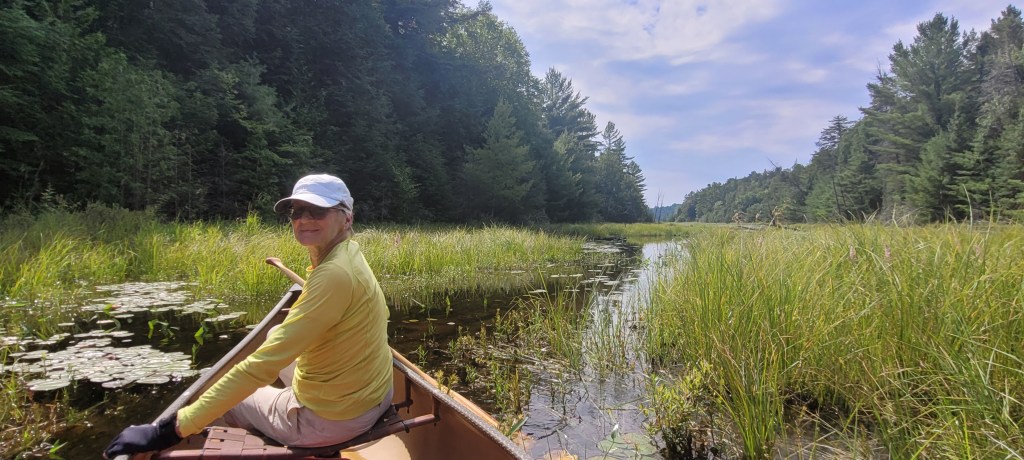
Photo is of MA, my co-adventurer.


 Valerie Hickey, Writer
Leave a comment