Our relationship with time.
As we age, our future shrinks.
In our youth, we feel wealthy with a vast future ahead of us. It makes us happy. When we get older, we feel the loss, even if we had some great fun in the past.
It’s because humans have a preference for the future.*
We want to look forward to pleasure—adventures and capers, great sex and romance, good food and socials. And, even though life’s hard knocks—getting in a car crash, losing a loved one, being fired—are in the past, it gives us little solace.
We care more about future pains than past pains, future pleasures than past pleasures. Regret about the past takes a back seat to dread of a future event. Hope, a future-only thrust, trumps most everything.
This is our relationship with time. We want life to lay ahead.
It doesn’t. It’s a bit sad for those of us who see the runway shrinking.
Our relationship with our own story
Another preference we have is about the direction our life goes—toward growth or decline.
Let’s say before the age of 30, you win three gold medals and set the world record in your sport. You achieve so much in the first third of your life, it’s impossible to continue out-doing yourself.
Your life story becomes: She peaked early and then went downhill.
We don’t like that descending pattern.
We like an ascending life narrative—rags to riches, self-made, pulled up by bootstraps, against the odds. This is the narrative we prefer.
Person A has major achievements in her life before age 30, followed by a long period of decline and disengagement. Person B, on the other hand, starts out regular, and gradually has the same number of great achievements as person A over her lifetime, culminating in something significant.
Most of us would say B’s life is better.
In sum, we have two life-affirming preferences:
- A preference for the future (for life events to be available to us in the future.)
- Preference for an ascending life pattern (i.e., a growth arc is better than a decay arc.)
We are so interesting.
Do these preferences serve us as we age?
Yes. I’ll go out on a limb and claim that these preferences can serve us. But not equally. The preference for an ascending life pattern has the greatest potential for us. When we’re older, the sadness we may feel about our shrinking future can be assuaged by the nature of our pursuits throughout our life.
There are two types of pursuits—experiential (feels good in the moment) and non-experiential (purposeful beyond the moment).
Pursuing what feels good brings us momentary pleasure. Experiences like partying, a swim or a beer on a hot day, flirting, sex, communing with nature, playing sports, and more of what we call ‘good times’—these are the types of activities we prefer in the future. The experience makes us feel something, and so we look forward to more of that feeling. A lifetime of pleasures can give life a bit of a glow. But, since each event is momentary and bound in a unit of time, like a dot, they fade into memory. They don’t imprint upon us. They are here and then gone.
They alone are not the stuff of mitigating the sadness of a shrunken runway, a too-short future, and the loss of things to come. Although perhaps enjoyable, a life spent solely in pursuit of pleasures would be a shallow life.
A good life consists in more than momentary experiences.
Non-momentary activities, called non-experiential goods, are things like achievement, meaning, integrity, devotion, and knowledge. These goods lie outside of our relationship with time. They don’t depreciate. They don’t need to be in the future to be good. They shape a life.
They gild a life.
Even if you feel sad in older years, your achievements, if you have any, make your life better. They have value and meaning beyond the experience of pleasure. Achievement has an invisible cumulative effect, like a line. It shapes your character, your identity, your sense of self, and thus the decisions you make, the roads you take. At the end, your momentary pleasurable experiences will languish. But your achievements remain present in the substance of you.
As an example, my friend, a recovering alcoholic, shaped her life by quitting alcohol in her late twenties. With that, her life bifurcated. Now, in her seventies, she acknowledges that quitting saved her. She has devoted time to sponsoring others, speaking at meetings, and helping people shake this awful disease. Had she not quit, she’d be a lesser person. Not someone she’d like much.
This is achievement. And my view is that it serves as a counterweight to the sadness of a shorter future in older age.
Not bad. Life serves itself to the ageing.
Experiential or non-experiential?
If you’re thinking, which are which and how do I know, here are two rough tests** for telling experiential goods from non-experiential ones:
The first is: If you subtract the feeling, does the value remain? If no, it’s experiential.
Take romance. If you subtract the feeling, very little value seems to remain. That makes romance and similar activities experiential. However wonderful, sadly the glow of romance fades, as is the case with most experiential goods. But we’d still look forward to it happening again in the future. That’s human.
And the second test: Does it happen at a particular time? If no, it’s non-experiential.
Take an achievement, like having courage, being loyal, helping those in need, raising good kids, advancing the cure for cancer, keeping promises—these are not time-bound activities. Toward the end of a life, the gild of their effect remains.
(I’m after) a triple-whammy conclusion
One, as a consolation to older people for the sadness of a shortened future in which to enjoy life’s pleasures, take comfort in the meaningful pursuits that shaped your life.
Two, as a prescription for younger people, don’t waste time chasing solely experiential pleasures. Prioritize life-shaping goods now, and they’ll provide meaning later, because if you’re lucky, you too will grow older.
Three—the most exciting for me—is an argument against our damaging narrative about ageing.
How our culture thinks about ageing is fundamentally distorted. The narrative is relentlessly future-focused on the experiential goods we’re about to lose given most of life’s pleasures are behind us in older age. For women especially, the cultural narrative says:
‘You’re old, your best years are gone,’ (meaning: your youth, your looks, your fertility…)
The counter-narrative is:
‘Yes, much of life is behind me. That’s what makes this stage of life meaningful. I am living as the person my achievements made me. It’s not decline. It’s the fullness of what I’ve built.’
The current cultural narrative of ageing measures the wrong things, privileges the wrong goods, and in the end, misunderstands what makes a life valuable.
Imagine educating our young to pursue worthy goals in their lives, to create for themselves an ascending life pattern, consciously aware that they are building toward well-being when older. Ageing itself would be valued. And rather than feeling irrelevant and burdensome, older people would be esteemed.
Knowing how the cultural narrative is philosophically and fundamentally flawed gives the counter-narrative teeth. Next time a young person talks down to me under the assumption that I am obsolete, I may challenge her, or I may not do anything differently at all. But I will feel differently about myself. I will recall my achievements and hold my head high. And hope that she, if fortunate enough to grow older, will not be faced with the cultural belittlements of ageing. And that she will have a trove of achievements to comfort her. For she will certainly face the shorter runway.
* This reflection draws on work by philosopher Jeff McMahan, ‘Old Age and the Preference for the Future’ in The Cambridge Handbook of The Ethics of Ageing, edited by C.S. Wareham, Cambridge University Press, 2022, pp. 9-22. Any interpretation or emphasis is my own.
**The two-test distinction is not something McMahan himself formulates. I arrived at it while thinking through his concepts, with some help from an AI assistant.
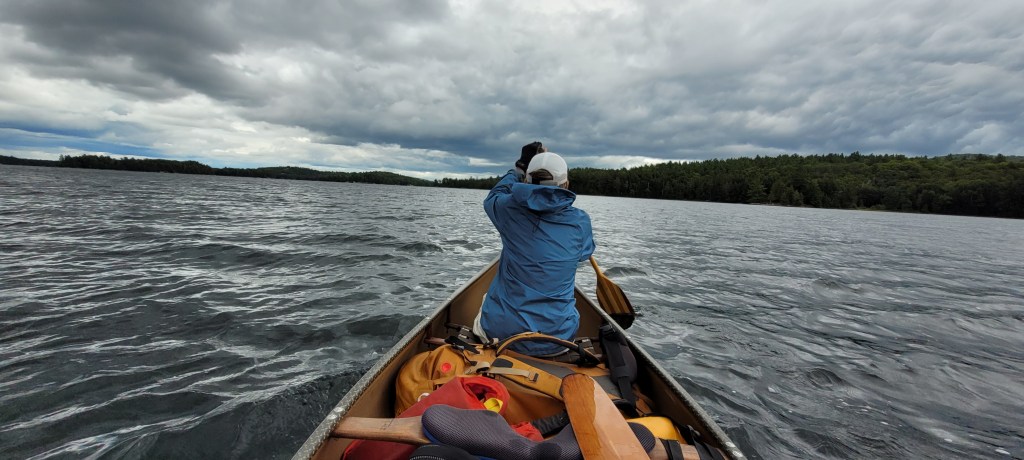
Photo: MA in the bow, summer 2025 adventure
 Valerie Hickey, Writer
Leave a comment