I’m sitting on a train that is so nice it feels like first class. I’ve just left the gorgeous modern green historic city of Lyon, the food capital of France. I stayed with a close friend. She loves cooking. I’ve never thought so much about food, and with that, the richness of a culture that is so good at it.
I’m on the way to Barcelona. We’re skirting the west Mediterranean now under a pink late afternoon sky. I’m writing a thesis proposal.
Could I be any happier?
I don’t think so.
Is this gerotranscendence?
Gero means aging, e.g., geriatrics, gerontology. Aging is wrapped in a negative stereotype. After living productive lives and, in many cases, generating wealth and wisdom for the next wave of humans, old people are often dismissed as frail, isolated burdens, a draw on limited resources. Grumpy. Irrelevant.
Another stereotype is that oldsters seek the ‘golden’ years—a.k.a., happy-hour-cheap-meals at four o’clock in the afternoon in Florida. Not my goal.
Is the bad rap because we’ve lost our hot good looks? Because we go slowly? Because we get discounts? Because we have white hair and don’t tiktok or insta every day?
To me, what is most wrong is being thought of as irrelevant.
Lars Tornstam is the coiner of gerotranscendence. His concept is that aging is another phase of development, just like teenage-hood and middle-age. Gerotranscenders are a work-in-progress. Here’s a partial list of what’s going on in gerotranscendence:
A decreased interest in material things.
A decrease in self-centeredness.*
An increased desire to understand oneself.
An increased need for solitude, or the company of only a few intimates.
An increased spontaneity that moves beyond social norms.
An increased sense of life’s ambiguity.
An increased affinity with, and interest in, past and future generations.
An increased acceptance of the mysteries of human life.
An increased joy over small or insignificant things.
An increased feeling of communion with the universe and cosmic awareness.
(Source: Summary of Lars Tornstam on Gerotranscendence)
*I think the best part of gerotranscendence is the shrinking of the ego, which dominated so much of the other decades. It’s like a lightness after a heavy yoke has been removed. Or like Sisyphus’s rock still needs pushing uphill most of the time, to remind us life is sometimes unfair. But, one, why would we expect life to be otherwise? And two, the rock is not that heavy after all.
My train is pulling into Barcelona. It’s dark now. I have an Airbnb to get to. Tomorrow, I’ll find an antique shop or a locksmith to have the Napoleon III boîte à gants I bought as a gift for my son opened.
The box mysteriously locked with the key inside.
Life is that mysterious; what series of events had to take place such that tomorrow I’d be walking the streets of Barcelona looking for a master key or a master locksmith?
The philosophies of life I’ve held since my youth come back to me for questioning. I learn more from them each time:
The unexamined life is not worth living. (Attributed to Socrates. I reckon it’s not true.)
Naïve you are if you believe life favours those who aren’t naïve. (Piet Hein in Grooks 1. It’s the antidote to Socrates.)
Can it still be true, she thought, that if you yourself are right, nothing that happens to you can ever be wrong? (A phrase from a Lin Yutang historical novel, title unknown. I love the emotional resonance—fear and anticipation—in the voice. It’s a moral question. I believe the answer is no and it’s quite alright.)
This is gerotranscendence: life starts as a stream that joins a river rushing over rocks and crashing over falls, then widening into the quiet delta until it merges with open water.** “And I’m experiencing it with a wow.”
**The metaphor of aging like a river’s journey to open water is Bertrand Russell’s; mine is a condensed summary.
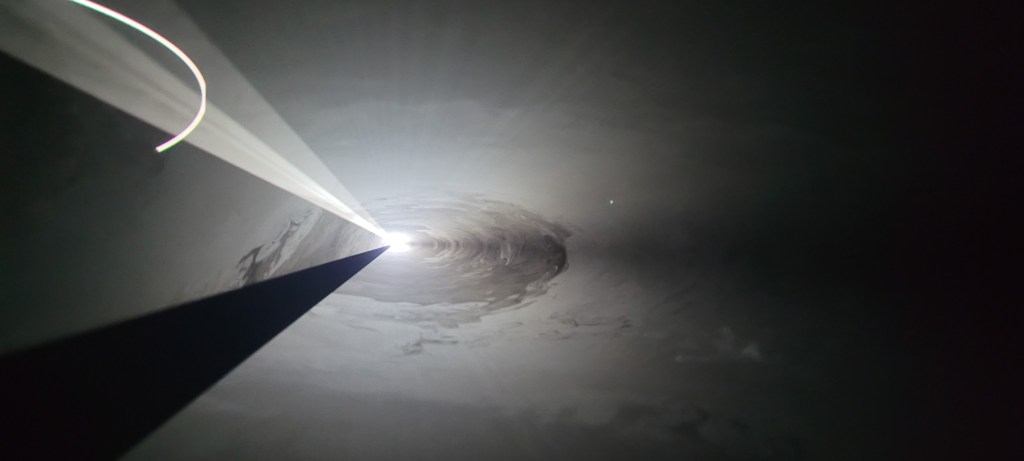
Above photo is of an exhibit called Solid Light, by Anthony McCall, Tate Modern, Dec. 2024.

 Valerie Hickey, Writer
Leave a reply to Edith K Cancel reply