Are the Irish Different?
I’m in Ireland, studying, and taking a class called: Are the Irish Different?
A clever leading question. Yes, of course they are. As an enquiry into Irish identity, the question is really: how are the Irish are different?
English rule over Ireland began in the C12th with the Norman Invasion. But by the early C20th, the Irish, having frequently and bloodily rebelled, finally became a republic in the 1940s. The Anglo-Irish, some of whom had been in Ireland for generations, soon became an in-between people, neither fully English nor fully Irish, experiencing the shift from privilege to displacement. Englishness is not a neutral identity here.
Fast forward to Canada, the colony, in mid to late C20th, and the Hickey dinner table where I grew up. I’m the product of an Irish (descendent) father and an English (descendent) mother.
How is it that the Hickey kids darkly understood that Mother, because of her Englishness, was superior to Father, because of his Irishness? It was conveyed through her raised chin, her gaze, and her quips, and equally through his downcast eyes, his shifting posture, and his deference.
After entrenching itself in Ireland, it (class, power, inequality) made its way across the Atlantic by ship, carrying, in the first instance, my Irish great-grand parents, and later in another, my English grand-father.
It seeped into kitchens, cocktail parties, job sites, grocery stores, playing fields, bars and everywhere people gather.
As a child, it made me aware of class. As a teen, it made me question (i.e., rebel against) the tenets of class. It established in me a critical eye for cultural narratives—of privilege, and then race, gender, sexual orientation, consumerism and now ageing.
The wisdom lies in becoming aware of the narratives. They are well-blended, as invisible as a hair-breadth thread. They have us dance to a tune we cannot even hear. *
But once you get the knack, you begin to witness the cultural norms and stories behind the glances, the pauses, the cold shoulder, the slurs and the gossip at the dinner table, at the party, in the recruitment office, and everywhere you get your media.
We need narratives. They give us a short-cut to facing the day-to-day. They embed the social codes that guide and unite us in right and wrong.
But their origin is sometimes no more significant than thoughtless gossip. In the right circumstances for a wily originator, what starts as an off-hand but timely comment may quickly and mysteriously become societal control and power—economic or social—and cause harm.
Stories are stories. They are not truth. The point is what we do with the cultural norms that make their way into the air we breathe and water we drink.
‘Coz they’ve been drip-feeding you fool’s gold since you were no more than ten years old.’ **
* This is a reference to ‘We dance to a tune we cannot even hear’, a paraphrasing of a Friedrich Nietzsche line about individuality calling us to live by our own rhythm, even if others think we’re insane. But I use the phrase as a metaphor for invisible norms and inherited behaviours.
**Lyric from ‘Fool’s Gold’ by Irish musician and classmate, SAOL (Spotify)
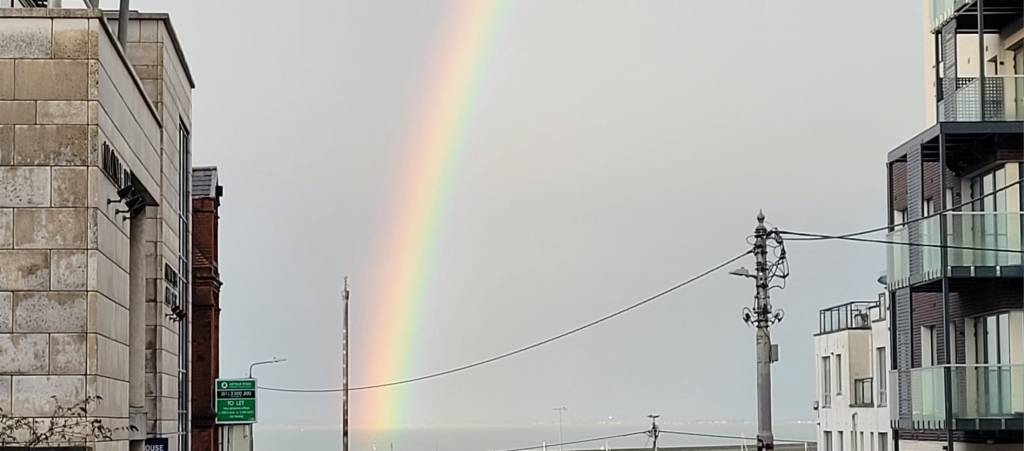
Photo: A woman on a bus told me Ireland’s rainbows are the brightest.

 Valerie Hickey, Writer
Leave a reply to peacesecretly337d392e8f Cancel reply